
Information and Communications Technology (ICT)
Transforming Education through Technology
Aligned with MOE's EdTech Masterplan 2030: "Technology-transformed learning, to prepare students for a technology-transformed world."
Our department's mission is to equip students with relevant ICT skills for the future, nurturing them as independent and lifelong learners — values that sit at the heart of the EdTech Masterplan 2030.
Our structured IT programme begins in Primary One, giving every child a strong foundation for their learning journey ahead. We also invest in equipping our teachers with the skills and tools to make learning more meaningful and relevant — reflecting the Masterplan's commitment to supporting both students and educators through technology and the core Digital Literacy and Technological Skills (DLTS) "Find, Think, Apply, Create" framework.
iPad 1:1 Access — Curate. Create. Collaborate.
Every student has access to an iPad, empowering them to take ownership of their learning anytime, anywhere.
Through Curate, students discern and distil meaningful information as digitally literate learners.
Through Create, they leverage digital tools to develop solutions as empathetic innovators.
Through Collaborate, they co-construct and share knowledge as connected 21st century learners — becoming digitally empowered, future-ready innovators aligned with MOE's EdTech Masterplan 2030.
ICT Programme
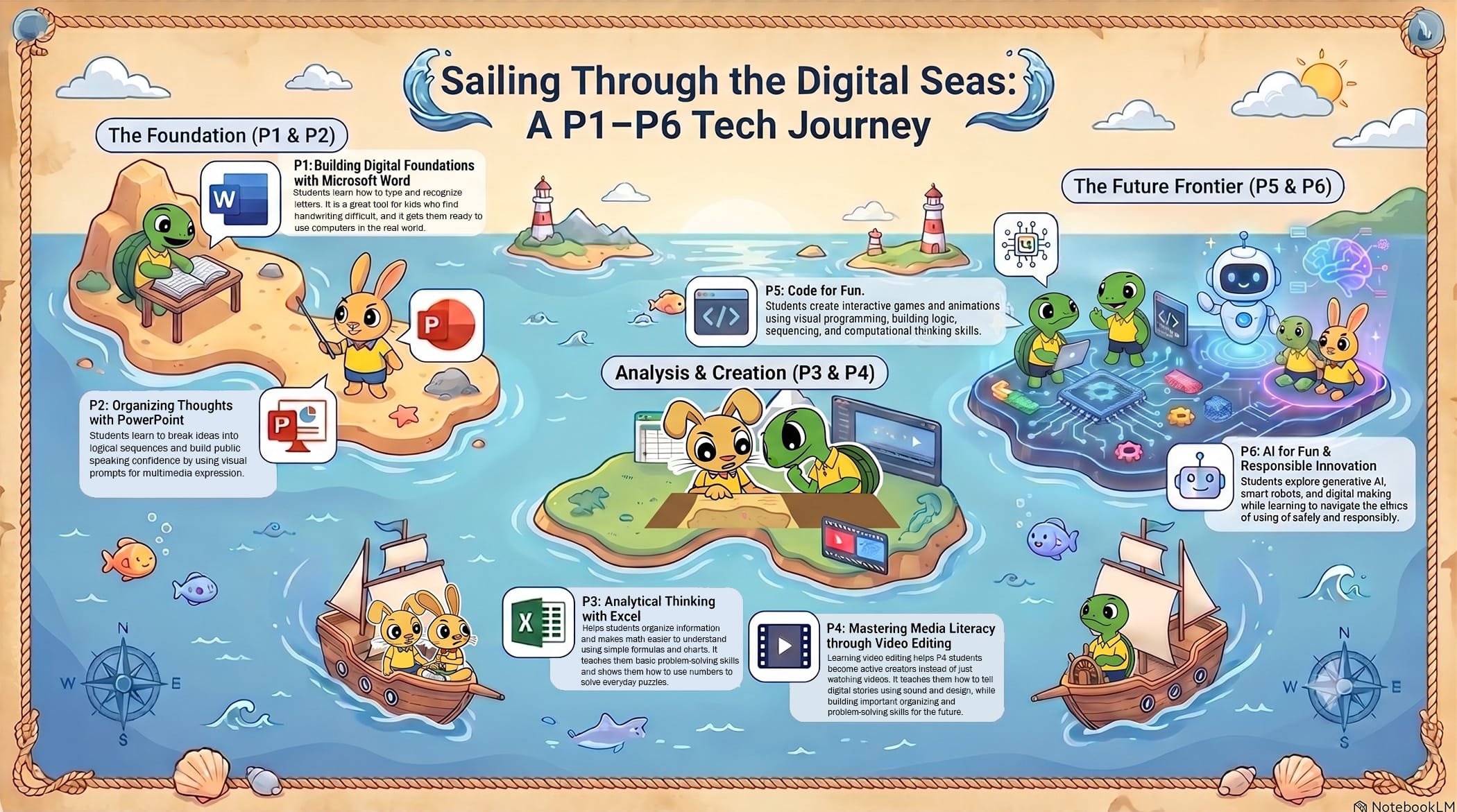
Admiral's ICT Learning Journey
Building Future-Ready Skills, One Step at a Time
ICT Programme
Level | ICT Programme | Programme Description & Objectives | Digital Literacy and Technological Skills (DLTS) |
P1 | Microsoft Word | Builds essential keyboard literacy and fine motor skills early. Reinforces reading and phonics through letter recognition, boosts confidence for handwriting struggles, and teaches basic tech mechanics—preparing them to confidently create and communicate in a digital world. | DLTS: Apply Outcome: Digitally Literate Learners Establishes foundational tech mechanics and device operations, serving as the essential building blocks for basic digital readiness. |
P2 | PowerPoint | Organizes thoughts logically by breaking ideas into sequences. Builds public speaking confidence using visual prompts, combines literacy with creative multimedia, and refines digital coordination through drag-and-drop actions. | DLTS: Apply & Create Outcome: Collaborative & Connected Learners Empowers students to utilize digital tools to logically co-construct, sequence, and communicate their ideas to an audience. |
P3 | Excel | Transitions into analytical thinking by organizing data into rows/columns. Makes abstract math concrete through simple formulas, introduces data visualization via charts, and builds early computational logic for solving real-world puzzles. | DLTS: Think & Apply Outcome: Technologically-Adept Innovators Transitions students into data literacy and computational logic, equipping them to use digital platforms to analyze information and solve practical problems. |
P4 | Video Editing | Shifts students to conscious media creators rather than passive consumers. Enhances digital storytelling, builds critical media literacy, and synthesizes design and audio skills. Teaches project organization and technical problem-solving. | DLTS: Create Outcome: Digitally Literate Learners Cultivates media literacy and project management, enabling students to creatively synthesize digital assets while exercising Cyber Wellness as conscious content creators. |
P5 | Code for Fun | Equips students with foundational computational thinking skills and basic coding knowledge through hands-on learning. Nurtures logical reasoning, problem decomposition, and algorithmic thinking to build baseline digital literacy. | DLTS: Think Outcome: Future-Ready Innovators Deepens computational thinking and algorithmic logic, directly supporting the Masterplan's mandate for baseline coding skills and technological adaptability. |
P6 | AI for Fun | Introduces basic Artificial Intelligence (AI) concepts and applications in an accessible way. Builds awareness of how AI works in everyday life, fostering curiosity and developing a foundational AI-ready mindset. | DLTS: Find & Think Outcome: Digitally-Empowered Learners Demystifies emerging tech and builds an AI-ready mindset, preparing students to safely navigate and leverage tools in a "technology-transformed world." |
Cyber wellness programme
The school's Cyber Wellness programme is delivered through CCE Form Teacher Guidance Period (FTGP) from Primary 1 to 6, progressively nurturing students as safe, discerning and responsible digital citizens.
P1 — Staying Safe in the Cyberworld: Students learn the basics of online safety and how to navigate the digital world securely.
P2 — Do I Know You: Students learn to manage online peer interactions and identify trustworthy sources.
P3 — A Healthy Balance: Students develop healthy screen time habits and a balanced relationship with technology.
P4 — Whom I Can Trust Online & I'm in Control: Students strengthen their ability to evaluate online content and take ownership of their digital behaviour.
P5 — Be a Cyber Champion: Students are empowered to model and promote positive online culture within their community.
P6 — My Digital Footprint: Students learn to manage their online presence responsibly and with integrity.
Through this progressive journey, students grow into digitally empowered, future-ready learners who use technology safely, responsibly and meaningfully.